Welcome to the mysterious world of the corvids
– crows, ravens, jackdaws, rooks, magpies, jays, and all their remarkable relatives.
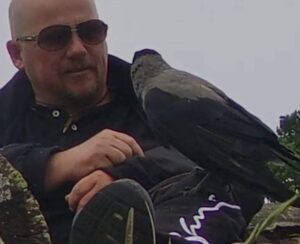
I call myself The Crowman because I’ve spent countless hours over many years befriending these incredible beings.
I’ve watched them, listened to them, spoken with them, laughed with them – and learned far more from them than I ever expected.
My goal? To open your eyes to their brilliance… and maybe even let their stories echo in your dreams.
Corvids (Corvidae) are among the most intelligent and adaptable birds on the entire planet.
They are social, curious, inventive – and true survivors.
In Denmark, we have seven of these masterpieces of nature:
the hooded crow, carrion crow, jackdaw, rook, magpie, Eurasian jay, and the raven.
Let me take you on a journey through their world – and show you why each species has something extraordinary that deserves our respect, curiosity, and pure admiration.
Jackdaw (Corvus monedula)
What It Looks Like
The jackdaw is the small, elegant acrobat of the crow family — compact, lightning-fast, and with a gaze you never forget.
It has:
-
a black body with a beautiful silver-grey “cloak” on the neck
-
a dark, helmet-like cap of feathers on the head
-
and the characteristic glowing ice-blue eyes that look straight through you
The jackdaw’s stare is one of the most expressive in the entire bird world.
If the hooded crow is the philosopher and the raven is the Viking, then the jackdaw is the little street performer — always alert, always watching, always aware of every detail.
Behaviour & Social Rules
Jackdaws are extremely social.
They live in tight-knit groups, almost like little families or neighbourhoods.
They:
-
fly together
-
sleep together
-
find food together
-
and constantly gossip about new discoveries
They form strong bonds with one another — and yes, they can also bond with humans.
Many jackdaws choose one specific human friend, whom they follow and communicate with.
And here’s something important:
Jackdaws are known for keeping track of human faces.
Like crows and ravens, they remember you — for a long time.
Where They Live
Jackdaws are common throughout Denmark, especially in:
-
cities
-
villages
-
gardens
-
cemeteries
-
old buildings
-
forests and parks
They love holes, crevices, and sheltered spaces where they can build nests, and they’re not afraid of humans.
That’s why you often hear their small, chattering calls around houses and rooftops.
In winter, they join rooks, crows, and magpies in large, lively roosts, settling down in groups of hundreds — sometimes thousands.
Food
Jackdaws are omnivorous little problem-solvers. They eat:
-
insects
-
seeds
-
berries
-
small animals
-
food scraps
-
kernels
-
and anything else they can find in nature or urban environments
Their curiosity makes them excellent discoverers.
It’s often the jackdaws who find new food sources first — and then tell the rest of the flock where the party is.
The Jackdaw & The Crowman
Many jackdaws seek me out throughout the year. They’re curious, quick, and bold.
It’s not unusual for a jackdaw to land close to me, check whether I brought snacks, or simply observe what I’m doing.
Those little blue eyes give everything away.
If a jackdaw likes you, you’ll know it — and if it doesn’t, you’ll know that too.
The Rook (Corvus frugilegus)
What It Looks Like
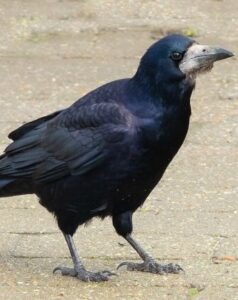
The rook is the elegant aristocrat of the crow family — slender, long-legged, and with an almost royal posture.
It has:
-
deep black feathers that shimmer with purple, blue, and green tones in sunlight
-
a long, pointed beak
-
and in adult birds: the distinctive pale, bare base of the beak, which gives them away from a long distance
Only adults have that pale “bald” patch at the base of the beak.
Young rooks, on the other hand, look so much like carrion crows that even ornithologists sometimes need a second look.
Behaviour & Social Relationships
Rooks are extremely social. They don’t do anything alone if they can do it together.
They:
-
live in colonies
-
build nests in colonies
-
fly in large formations
-
and make noise in chorus (often all day long)
Rook colonies are like small treetop cities — full of drama, family intrigues, alliances, and constant communication.
It’s nature’s version of a busy village with hundreds of neighbours, all convinced they have something important to say.
And yes: they can be loud.
But their noise is also a sign of a strong social structure and good overall wellbeing.
Where They Live
Rooks are found throughout Denmark, especially:
-
around farmland
-
in large parks
-
in urban woodlands
-
and near open fields where food is easy to find
In spring, they build huge colonies that can fill entire treetops.
They are among the most faithful nest builders in the bird world — many colonies remain in the same place for decades.
When winter arrives, rooks often join jackdaws, hooded crows, and carrion crows in communal roosts.
There you can see thousands of them dancing across the sky in beautiful, dark waves.
Food
Rooks are specialised foragers that love:
-
insects
-
worms
-
larvae
-
seeds
-
grain
-
nuts
-
and the occasional small animal
They use their long beaks like nature’s tweezers, probing the soil for hidden treats.
They can also adapt — and like all corvids, they’re not above grabbing food scraps or easy snacks if the opportunity appears.
The Rook & The Crowman
Rooks often visit me in large groups, especially in winter.
They sit in the treetops and loudly comment on everything I do — behaving like an audience that simply must share its opinion.
There is always one rook who takes the lead and shouts the loudest… and the rest follow.
When rooks accept you, they do it as an entire flock.
It’s never just one friend — it’s the whole neighbourhood.
Eurasian Magpie (Pica pica)
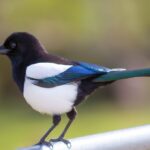
The magpie is one of the most intelligent and easily recognizable birds in the crow family.
It is found throughout large parts of Europe, Asia, and North Africa, and is known for its striking appearance, high intelligence, and curious behaviour.
Appearance
-
Black-and-white plumage with a long, iridescent blue-green tail
-
Shiny black head, chest, and wings
-
White shoulders and belly
-
The long tail makes up more than half of the bird’s total body length
The magpie’s glossy colours are especially vivid in sunlight, giving it a metallic, almost jewel-like sheen.
Distribution
-
Widely distributed across Europe, including Denmark, England, Ireland, and Scandinavia
-
Also found throughout much of Asia — from the Middle East to Russia and China
-
Lives in forests, parks, cities, farmland, and suburban neighbourhoods
-
Extremely adaptable and thrives close to humans
Intelligence
-
One of the smartest birds in the world
-
One of the very few animals capable of recognizing itself in a mirror
-
Can use simple tools, solve puzzles, hide food, and plan ahead
-
Has advanced communication skills and excellent memory
-
Learns quickly from both experience and other birds
The magpie’s problem-solving ability rivals that of some primates.
Behaviour
-
Often lives in pairs or small social groups
-
Builds large, dome-shaped nests
-
Eats almost anything: insects, berries, fruit, small animals, eggs, carrion, and food scraps
-
Very curious, bold, and investigative
-
Keeps a close eye on its surroundings and reacts instantly to new stimuli
Cultural Significance
-
Known from folklore and legends throughout Europe
-
Often portrayed as mischievous and clever due to its personality
-
Symbolizes intelligence, communication, adaptability — and sometimes luck
Eurasian Jay (Garrulus glandarius)
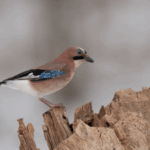
The Eurasian jay is one of the most colourful and eye-catching members of the crow family.
It lives throughout much of Europe and Asia, and in Denmark it is well known for its striking plumage, loud calls, and impressive intelligence.
Appearance
-
Light brown / pinkish-brown body
-
A distinctive black “moustache” stripe by the beak
-
Black-and-white markings on the wings
-
A striking blue wing patch with turquoise, black, and white stripes
-
Black tail and a pale, slightly streaked crown
A beautiful and unmistakable bird in the forest.
Distribution
-
Found across all of Europe and large parts of Asia
-
Common in Denmark — especially in forests, parks, and large gardens
-
Prefers deciduous forests but also lives in mixed woodlands and near residential areas
Intelligence
-
One of the most intelligent corvids
-
Can mimic sounds — including other birds, animals, and sometimes humans
-
Has excellent memory and caches thousands of acorns for the winter
-
Capable of planning, problem-solving, and navigating large territories
The jay’s ability to remember where it has hidden food is extraordinary.
Behaviour
-
Often shy and stays hidden among the trees
-
Lives in pairs or small family groups
-
Known for flying silently and gracefully through the forest
-
Diet includes insects, acorns, fruit, seeds, nuts, eggs, small animals, and food scraps
-
Plays a major role in forest growth — many hidden acorns eventually grow into new oak trees
Cultural Significance
-
Known as “the guardian of the forest” — it gives loud alarm calls when predators or humans approach
-
Symbolizes long-term thinking, planning, and protection
-
In old folklore, the jay was seen as a bird with secret knowledge of the forest