The Hidden Genius of Crows: Surprising Facts You Didn’t Expect

Crows: Nature’s Fascinating Geniuses
Crows are among the most intelligent birds on the planet.
They use tools, solve complex problems, and can recognize human faces with remarkable accuracy.
They remember who treated them well — and who didn’t — and they act accordingly.
Their astonishing adaptability and ability to learn make them truly exceptional in the bird world.
The Intelligence of Crows
Crows are masters of problem-solving and planning ahead.
They cache food for the future and remember the exact hiding place weeks later.
In laboratory studies, crows have solved multi-step puzzles and even invented new strategies simply by observing other crows. (Iowa Now, ScienceDirect, PMC)
And one of the most intriguing discoveries:
After using tools, crows actually show signs of increased optimism —
as if the very act of solving a problem puts them in a better mood.
(Harvard Gazette)
I’ve witnessed moments that point to this kind of forward-thinking myself.
Once, it seemed as if a crow deliberately called me over to help another crow that was injured —
as if it knew what I could do, and intentionally sought my assistance.
Experiences like this support an idea many researchers now lean toward:
Crows don’t just react to the moment.
They predict.
They evaluate situations, think ahead, and act with intent —
a level of cognition only a handful of animals on Earth are capable of.
Social Structure & Communication
Crows live in remarkably complex social communities with clear hierarchies.
They communicate through a rich language of calls, sounds, and body signals — warnings, dominance, curiosity, play, and social bonding.
Some species can even mimic human voices, showing impressive vocal flexibility.
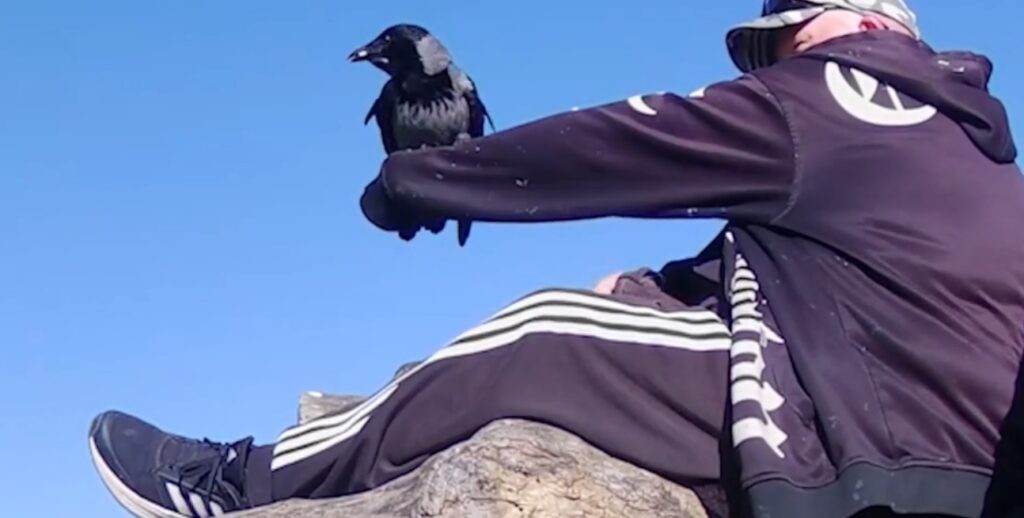
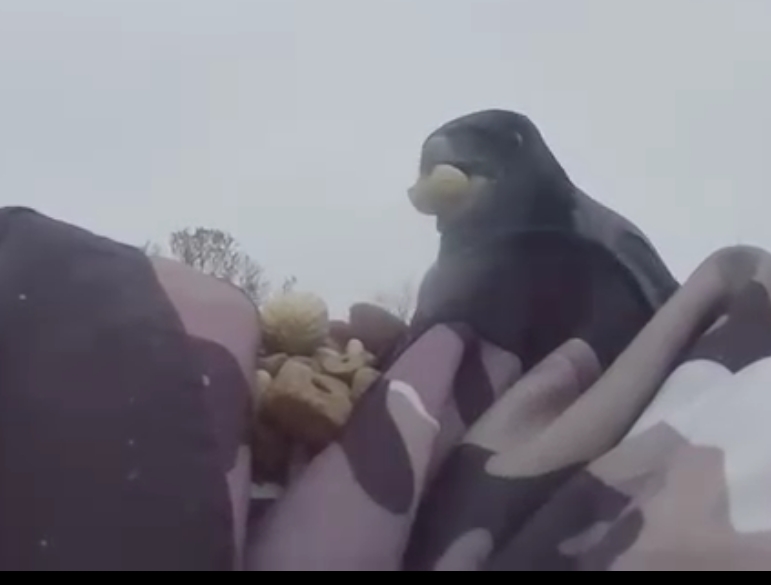
When I’m with my local crows, I often use a training clicker as a signal.
Over time, both they and I have learned each other’s sounds and gestures — almost like a shared language that grew naturally between us.
Some crows perch high in the treetops acting as lookouts, while others search for food below.
Their alarm calls shift depending on the distance of a threat:
faster and sharper when danger is close; deeper and calmer when it fades.
Crows use an incredible variety of sounds and signals:
-
Alarm screams – when a threat approaches
-
Social calls – for flock communication
-
Whispers, clicks, and rattles – close-contact communication
-
Boing-, pop-, and beep-like sounds – often paired with specific body postures
I’ve witnessed dramatic moments that reveal how deep their social bonds run.
One night, while I slept on the beach, I woke to hundreds of crows circling and calling above me.
I believe they thought I was dead; they do the same when one of their own has fallen.
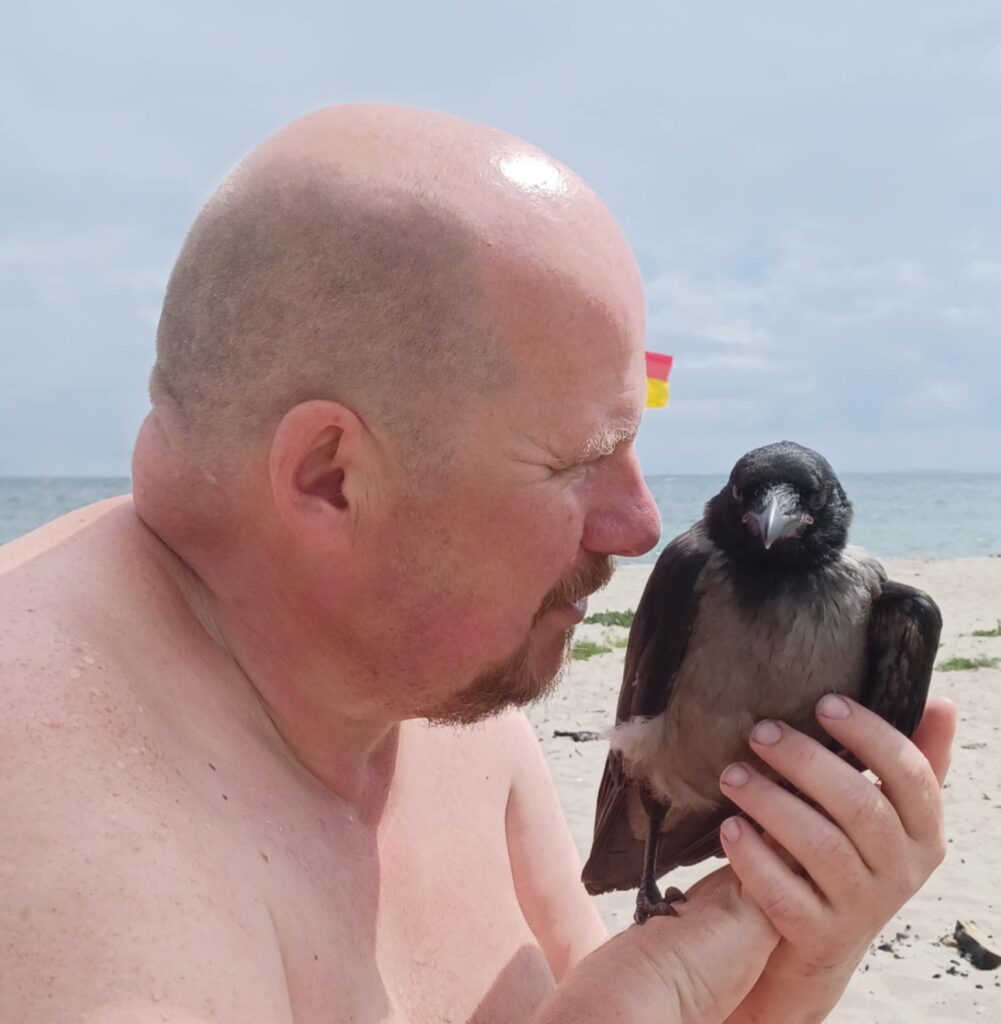
Later, when my crow friend Blackie died, young crows tried to guide me to her body.
When I placed small gifts — flowers, shells — and sat quietly beside her, around forty crows watched in complete silence from the trees.
After a few minutes, a small group landed beside me and followed me almost all the way back to the car.
Crows can even have regional dialects — different areas or “clans” use vocal patterns that others do not.
Culture & Traditions
Crows display behaviors that resemble culture — knowledge passed from one generation to another.
Young crows learn hunting strategies, social rules, and warning signals from older birds.
They are also known to perform rituals that resemble funerals, gathering around a fallen crow.
I’ve witnessed such gatherings myself — and many times, the crows included me as if I were part of the circle, sitting in silence beside me as though we shared the moment together.
If a stranger disturbs the body too early, the flock often reacts with clear distress.
I’ve seen this firsthand.
Their grieving process is deeply social — and interrupting the ritual can cause agitation and alarm.
Adaptability
Crows are extraordinarily adaptable.
They live everywhere: big cities, forests, mountains, farmland, fields, coastlines.
They eat almost anything and adjust their diet to whatever the habitat provides.
Even their nests reflect their ingenuity — a mix of natural materials and objects left behind by humans.
It shows their inventiveness and their ability to make use of any resource.
Ecological Role
Crows play a crucial role in the ecosystem:
-
Scavengers: They clean up dead animals and reduce disease risks.
-
Seed spreaders: They eat fruit and disperse seeds that grow into new plants and trees.
-
Pest control: They keep insect and rodent populations in check.
They are nature’s cleaners, guardians, and rebuilders.
Crows and Humans
Throughout history, crows have symbolized wisdom, mystery, and transformation.
Yet they are often misunderstood and treated as pests — a tragedy, considering their intelligence and the benefits they provide to both people and the environment.
Crows adapt to human presence — sometimes even working indirectly alongside us.
They follow people, learn our routines, and engage at shared feeding spots.
Most conflicts between humans and crows come from misunderstandings, not real problems.
A Truly Unique Bird Family
Crows are not just loud, black birds with a bad reputation.
They are nature’s geniuses.
Their intelligence, social structures, and adaptability make them some of the most successful and fascinating birds in the world.
It’s not an exaggeration when researchers say that crows outperform young children in certain problem-solving tasks —
and surpass dogs and even some primates on specific cognitive challenges.
Biology & Lifespan
In the wild, many crow species typically live 7–8 years,
but many reach 10–15 years, and protected individuals can live even longer.
Some tame or protected crows have reached 30 years,
and there are reports of a crow living to around 59 years (though this is debated).
Crows have excellent vision, a wide field of view, and can recognize:
-
human faces
-
body shapes
-
cars
-
dangers
-
and even individual animals
Their beaks are strong enough to crack nuts, break bones, and tear meat into strips.
Partnerships
Most crow species are socially monogamous — pairs often stay together for years, sometimes for life.
Even when there are occasional side-pairings in some populations, the bonded pair remains a team:
they build their nests together, feed their young together, and defend their territory as a unified partnership.
Responses