When the Cup Overflowed (Living with PTSD)
My journey began on a day when life felt heavy, and I unexpectedly found peace in the company of a wild flock of crows.
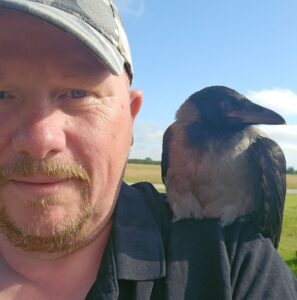
What started as a simple meeting in the forest grew into a kind of crow therapy — something that later became known nationwide after I shared my story in a TV2 segment (Danish TV).
Since then, the crows have followed me through thick and thin — and I’ve followed them.
They can plan, cooperate, recognize people, and some of them visit me every single day like old friends.
For the best experience, this website is best viewed on a computer rather than a mobile phone.
The Danish Corvids
A world of black and grey feathers — of intelligence, play, teamwork, and small everyday miracles.
Once you see corvids through my eyes, you will never see them
 When the Cup Overflowed (Hit by PTSD)
My journey began on a day when life felt unbearably heavy — and I unexpectedly found peace in the company of a wild flock of crows.
What started as a quiet moment in the forest turned into a kind of crow therapy, which later became known nationwide when I appeared in a segment on TV2 (a large national TV station in Denmark).
Since then, the crows have stayed with me through everything — and I’ve stayed with them.
They plan, they cooperate, they recognize people… and some of them seek me out every single day like old friends.
The Danish Corvids
A world of black and grey feathers, intelligence, mischief, teamwork, and tiny everyday miracles.
Once you see corvids through my eyes… you’ll never see them the same way again.
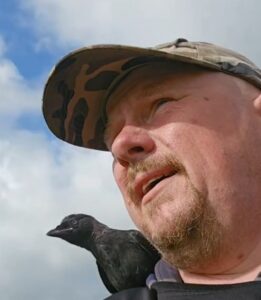
My name is Claus, but most people know me as The Crowman.
I spend much of my time observing, understanding, and “befriending” crows, ravens, jackdaws, rooks, magpies, and Eurasian jays.
They belong to the bird family Corvidae, some of the smartest, most social, and most adaptable creatures on Earth.
And that’s exactly why I became completely, hopelessly fascinated with them — even though I never cared about birds before.
Besides my work with the birds, I also create music inspired by crows, nature, and the experiences I share with them.
To me, it all connects: the birds, the freedom, the creativity, and the calm they bring.
Denmark has seven corvid species that breed here.
Each one has its own personality, its own voice, and its own brilliant little tricks — from the jay’s ability to hide thousands of acorns to the raven’s advanced problem-solving.
I’ve been lucky enough to befriend six of the seven species.
The only one I still struggle with is the shy Eurasian jay — it’s so skittish that building trust is a long, delicate process.
Come with me into their world.
I, The Crowman, promise you this:
Once you see corvids through my eyes, you’ll never see them the same way again!
 Who Is the Crowman?
Hi there! My name is Claus, but lots of people call me The Crowman.
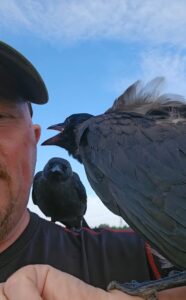
Why? Because I’m really good friends with crows, ravens, jackdaws, rooks, magpies, and jays — yes, all the clever, feathery troublemakers!
It all began on a day when I felt a little sad.
I was walking in the forest when suddenly a crow came right up to me.
It sat down, looked straight at me, and almost said:
“Hey… it’s going to be okay.”
From that day on, the crows started following me everywhere.
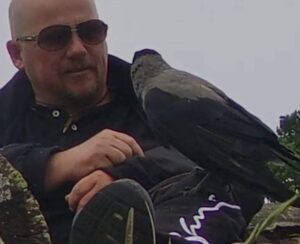
Some sit on my arm, some fly with me through the woods, and some visit me every single day just to say hello.
I learned something magical: when I felt sad, the crows could make me happy again.
I call that crow therapy — and it became so famous that I even talked about it on TV2!
Now I make music about crows, record my adventures, and teach others how to become good friends with them too.
Corvids are some of the smartest birds on the whole planet.
They can do tricks, find food, solve puzzles — and they even remember your face if you’re kind to them.
If you take care of crows…
they take care of you right back.
So welcome to my world — a world full of
“kraaaa!” sounds, flapping black feathers, and fantastic friends in the treetops.
About Me – The Crowman
My name is Claus, but around Moesgård Beach and in this community, most people know me simply as The Crowman — educator, nature enthusiast, course creator, programmer, creative developer, artist, and the person behind this platform dedicated to the world of corvids.
My interest in crows began as a deeply personal journey.
During a difficult period marked by PTSD, I found unexpected calm, comfort, and presence in the wild corvids around me.
What started as quiet moments turned into what I now call crow therapy, which later gained national attention when I talked about it in a TV2 segment.
Over the years, I’ve built a unique connection with several local crow flocks.
They recognize me, follow me, and interact with me in both forests and urban spaces.
My work today focuses on documenting these encounters, sharing knowledge about corvid intelligence and behaviour, and helping people understand and respect these often misunderstood animals.
Alongside my nature work, I compose and produce music inspired by crows — their sounds, their energy, and the stories we create together.
I share knowledge through videos, articles, talks, and educational programs, combining personal experience with current research and accessible science communication.
But deep down, I dream of becoming a crow rehabber and opening a rehabilitation center for injured or orphaned corvids — something that, unlike in other countries, is still very rare in Denmark.
Here, the answer is too often:
“We can’t help corvids… the bird must be euthanized.”
I want to change that.
Creativity has always been part of who I am.
For many years, I’ve created commissioned graffiti artwork on facades and taught workshops.
Much of my earlier life was spent in front of computer screens, working as a concept developer, web designer, and programmer — building unique social media platforms for vulnerable groups from the ground up.
My tech-based initiatives have received awards and recognition for helping people break out of isolation and loneliness.
In 2012, I was honoured with Aarhus Municipality’s Disability Award for one of these projects.
My mission on kragemanden.dk is simple:
To show the world just how intelligent, social, and fascinating corvids truly are —
and to build a bridge between people and nature.
If you enjoy my courses, guides, articles, or the wonderful birds that appear in my videos, the crows and I would be incredibly grateful for a donation.
All contributions go directly to crow snacks and the care of injured wild corvids.
Support the crows — make a donation.
Hooded Crow & Carrion Crow (Corvus cornix & Corvus corone)
The hooded crow wears nature’s very own cloak — a beautiful ash-grey body with a coal-black head, wings, chest, and tail.
In some countries, people even call it a “hoodie”, and it fits perfectly: the black “hood” really does look like one.
The carrion crow, on the other hand, is completely black from beak to tail.
But if you look closely in the sunlight, you’ll see hints of metallic blue or green shimmering in its feathers — little secrets hidden in the dark.
Here’s a tiny nature miracle:
Hooded crows and carrion crows can have chicks together.
Their young often have a unique mix of grey and black feathers — almost as if nature picked up a paintbrush and created a brand-new artistic version of the crow.
One thing confuses many people: young rooks can look a lot like carrion crows.
You only see the difference when the rook grows older: its beak becomes pale and bare.
A crow’s beak, however, is always jet-black — even when they’re young.
Where do they live, and what do they do?
In Denmark, the hooded crow is the most common species. You can meet it almost anywhere:
fields, parks, forests, beaches — even right in the middle of the city.
The carrion crow mainly lives in southwestern Jutland and southern Zealand.
Both species stay in Denmark all year, but winter brings visitors.
When the cold sets in, huge flocks of crows from across Scandinavia arrive to spend the winter here.
They gather in the thousands at sunset in gigantic sleeping sites called roosts.
Imagine thousands of crows flying toward the same trees — calling, greeting, arguing, and settling in for the night.
A living cloud of black and grey bodies swirling overhead — it’s pure magic when you stand beneath them.
As darkness falls, they sit close together.
They do it to stay warm, protect one another, exchange information — and maybe even flirt a little.
Crows often pair for life.
Some take small “side adventures,” but most return to the same partner year after year.
I’m lucky to have my own crow friends in one of these large roosts.
From October to March, I meet crows from all over Scandinavia — and who knows, maybe some of them recognize me when they fly north again.
What do they eat?
Crows are true all-round eaters.
They take whatever nature offers:
-
seeds
-
insects
-
carrion
-
small animals
-
berries
-
nuts
-
food scraps
-
and much more
If it’s edible, a crow is always willing to try it.
Their varied diet and incredible adaptability are exactly why they thrive — both in the wild and right in the heart of our cities.
.
 Jackdaw (Corvus monedula)
The jackdaw is the smallest of Denmark’s corvids — but definitely one of the most charming.
It shares the black feathers of its larger relatives, but has a beautiful silver-grey neck and bright, pale blue-grey eyes that almost seem to glow when it looks at you.
Those eyes give it a clever, alert, and wonderfully curious expression.
Young jackdaws have darker eyes, but the pale colour appears as they grow older.
Where do they live?
Jackdaws love towns, villages, church towers, chimneys, old tree hollows, and farm buildings.
They rarely build their own nests — they find them instead.
A hole in a tree? Perfect.
A hole in a roof? Even better.
They live in tight-knit social groups and often stay together in large family communities.
Many return to the very same area year after year.
Behaviour and Life
Jackdaws are among the most socially intelligent corvids. They can:
-
recognize human faces
-
work together to solve problems
-
hold “family meetings” and warn each other
-
understand the hierarchy within their flock
If you ever earn a jackdaw’s trust, you may have a friend for life.
What do they eat?
They eat seeds, insects, larvae, small animals, berries, and food scraps.
Jackdaws also love collecting shiny objects — not because they are “thieves,” but because they are curious and use objects for both play and learning.
 Rook (Corvus frugilegus)
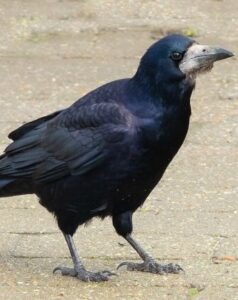
The rook can look a lot like the carrion crow from a distance, but adult rooks are easy to recognize. They have:
-
a pale, bare beak
-
a light, ghost-like patch of facial skin
-
glossy black feathers that shine with metallic colours
Young rooks, however, have black beaks — which is why they’re often mistaken for crows.
Where do they live?
You’ll find rooks living in large colonies — sometimes hundreds of nests in the same tall trees.
They love open fields, meadows, sports grounds, and areas near towns where they can hunt for worms and insects.
A rook colony is like a noisy little village.
They communicate nonstop, hold meetings, argue a bit, perform aerial shows — and look out for one another.
Behaviour and Life
Rooks are social to the core. They:
-
build nests close together
-
help one another raise chicks
-
share information about food
-
defend the colony as a united group
When flocks of rooks sweep across winter fields in great waves, it looks like a living carpet of black birds rolling across the sky.
Feeding Habits
Rooks love to eat:
-
earthworms
-
insects
-
seeds
-
grains
-
small animals
They often walk across fields and “listen” for movement underground — true experts at finding hidden food.
Magpie (Pica pica)
The magpie is nature’s elegant trickster.
It’s black and white like a classic tuxedo, but when the sun hits its feathers, you’ll see beautiful flashes of metallic blue and green on its wings and tail.
Its long tail works almost like a steering wheel, helping it glide and twist with perfect control in the air.
Where do they live?
Magpies live almost everywhere in Denmark — in towns, villages, and open countryside.
They build impressive dome-shaped nests with a roof on top to protect themselves from birds of prey.
Behaviour and Life
Magpies are incredibly smart. They can:
-
plan several steps ahead
-
solve complex tasks
-
store food and remember hundreds of hiding places
-
recognize themselves in a mirror (almost no animals can do that!)
They’re also known for their curiosity, which some people mistakenly think is “thievery.”
In reality, magpies are simply exploring new objects to learn about the world.
Food
Magpies enjoy a wide variety of foods:
-
insects
-
seeds
-
fruit
-
eggs
-
small animals
-
food scraps
They’re opportunists — just like the rest of their crow family.
å kendt for deres nysgerrighed, som nogle fejlagtigt misforstår som “tyvagtighed”.
I virkeligheden undersøger skader bare nye ting for at lære om verden.
Føde
Skader har en bred smag: insekter, frø, frugt, æg, smådyr, madrester
De er opportunister – ligesom deres krageslægtninge.
Eurasian Jay (Garrulus glandarius)
The Eurasian jay is the colourful member of the crow family — as beautiful as it is shy.
It has:
-
soft pinkish-brown feathers
-
a bright blue-and-black patterned patch on the wing
-
a black “moustache” stripe
-
a pale crown with thin black streaks
Where do they live?
Jays live in forests, parks, and large gardens.
They love oak trees, where they find their favourite food: acorns.
Behaviour and Life
Eurasian jays are famous for their incredible abilities. They can:
-
hide thousands of acorns for the winter
-
remember most of their hiding spots — even under snow
-
mimic sounds, including other birds and sometimes even human voices
They are nature’s own forest gardeners.
Every year, thousands of new oak trees sprout simply because jays forget some of their hidden acorns.
Food
Their diet includes:
-
acorns
-
nuts
-
fruit
-
larvae
-
beetles
-
small animals
A perfect mix of plant food and protein.
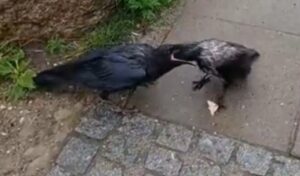 Raven (Corvus corax)
The raven is the largest and most majestic of all the crow family birds.
It has:
-
jet-black feathers
-
a powerful, curved beak
-
a wedge-shaped tail
-
deep, echoing calls: “krooo–kroook!”
A raven can grow as large as a small chicken and is an impressive sight in the air.
Where do they live?
Ravens live in forests, cliffs, wild open landscapes, coastal areas — and in some places, on the edges of cities.
In Denmark, the raven has made a remarkable comeback after many years as a threatened species.
Behaviour and Life
Ravens are among the smartest birds in the world. They can:
-
plan ahead and solve complex problems
-
use tools
-
play clever tricks
-
work together to open containers
-
form strong lifelong pair bonds
Ravens fly with the grace of a bird of prey, performing impressive acrobatics.
They communicate with a whole orchestra of sounds: clicks, growls, honks, croaks, whistles, and mimicry.
Food
Ravens are omnivores, but especially fond of:
-
carrion (they are nature’s cleanup crew)
-
small animals
-
fruit and berries
-
seeds
-
insects
-
food scraps
They play an important role in the ecosystem by helping keep nature clean from dead animals.